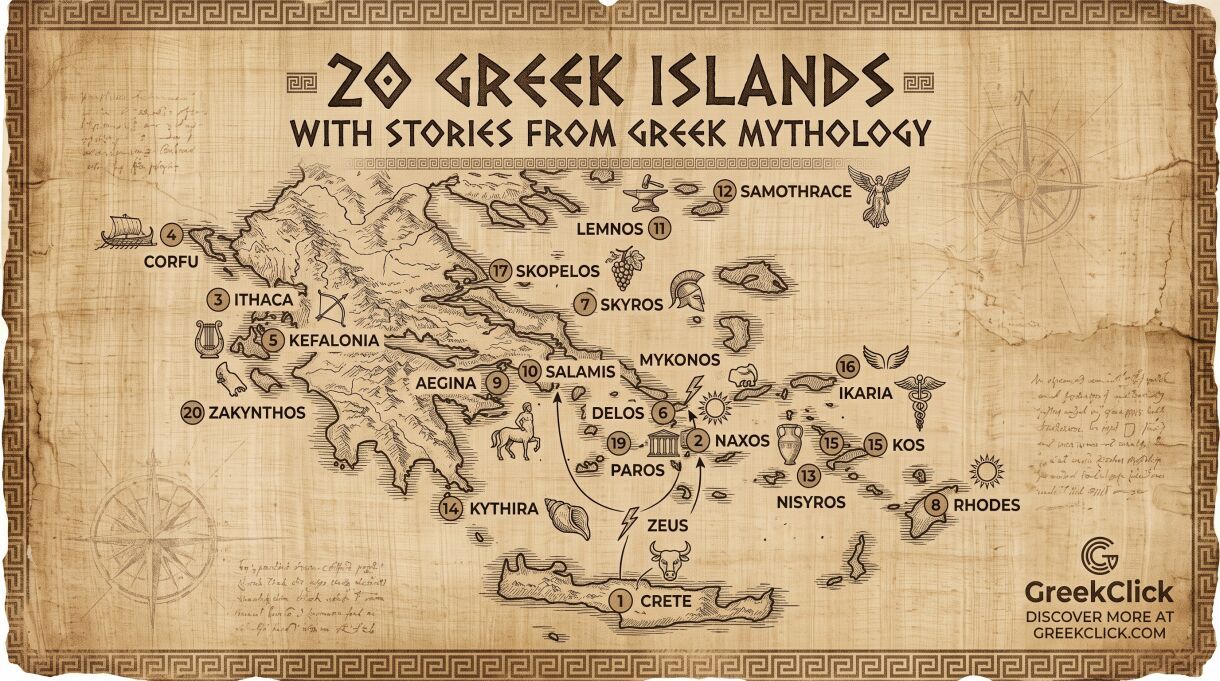
Why the World Is Rediscovering Ancient Greece
When we think of the Greek islands, we usually picture the Aegean Sea, beautiful beaches, whitewashed villages, deep blue waters, and summer holidays.
But many of Greece’s islands have a much older story to tell.
Behind today’s landscapes are ancient myths filled with gods, heroes, kings, monsters, and epic adventures.
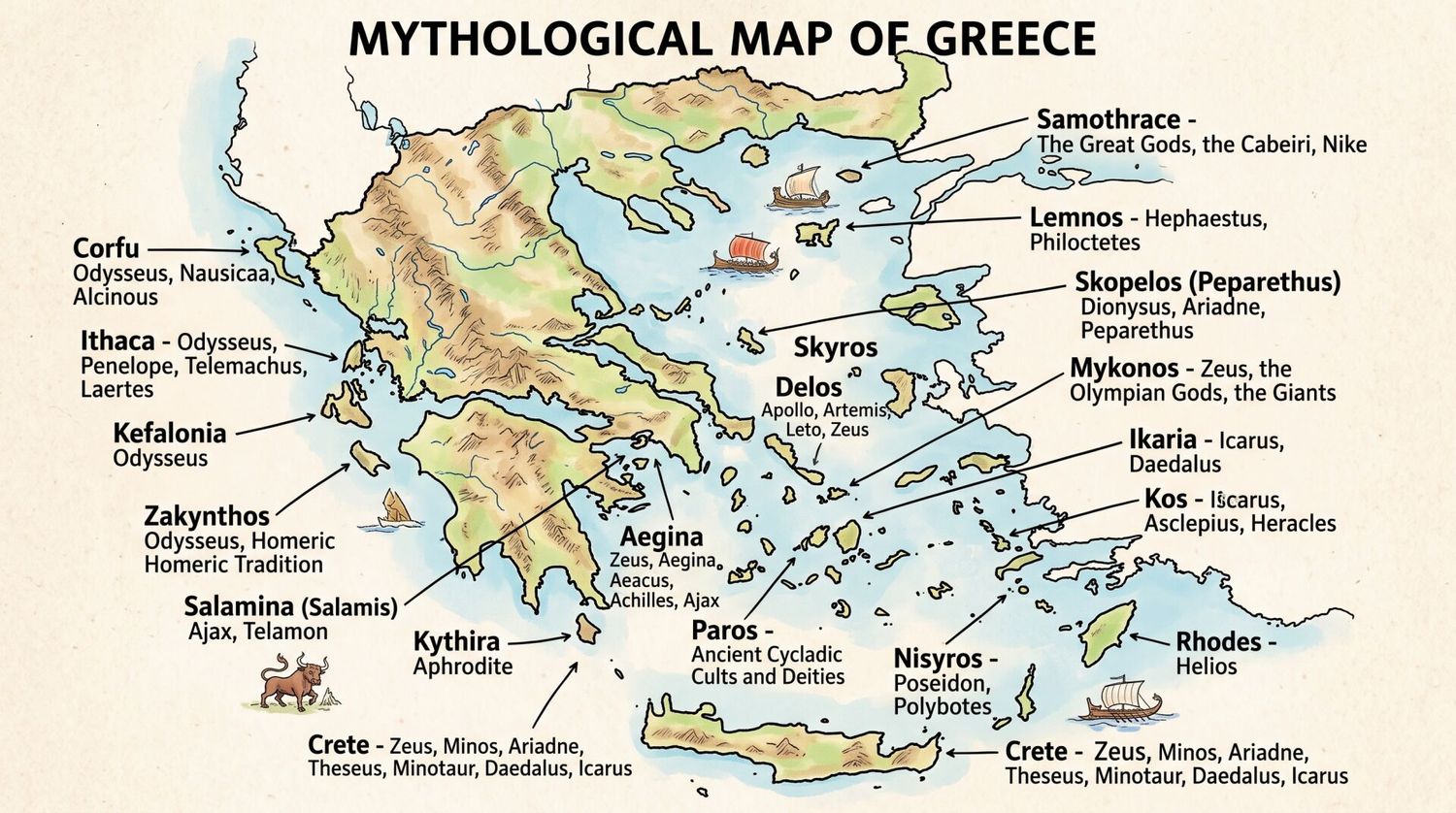
Odysseus travelled through the islands of the Ionian and Aegean seas. Theseus is connected with Crete and Naxos. Achilles with Skyros. Apollo and Artemis with Delos. Zeus with Crete and Naxos.
So let’s explore 20 Greek islands through the gods, heroes, and stories of Greek mythology.
1.Crete
Crete holds one of the most important places in the mythological map of Greece.
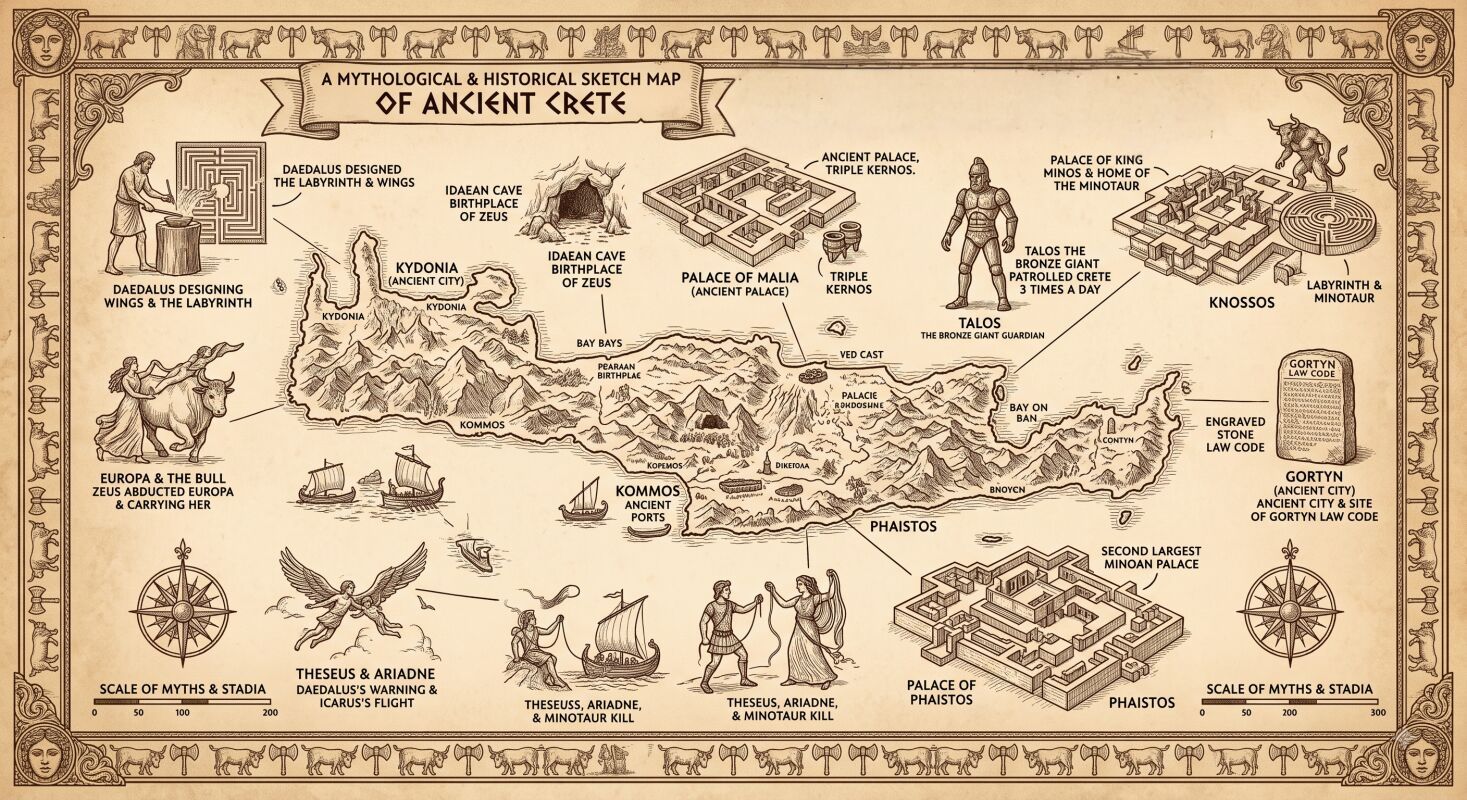
This artistic map blends mythology and history to illustrate ancient Crete's famous sites and legends, highlighting its rich cultural heritage and iconic figures from Greek mythology.
The island is associated with Zeus, who according to ancient tradition was raised in Crete, as well as with the legendary King Minos.
Knossos provides the setting for one of the most famous stories in Greek mythology: the Minotaur and the Labyrinth.
Theseus travelled to Crete to face the creature. Ariadne, the daughter of Minos, helped him find his way out of the Labyrinth.
The same mythological world also includes Daedalus and Icarus, creating an entire network of stories around Crete.
Mythological characters:
Zeus, Minos, Minotaur, Ariadne, Theseus, Daedalus, Icarus.
Naxos is closely connected with the story of Ariadne and Dionysus
After the events in Crete, Theseus arrives in Naxos with Ariadne. According to the mythological tradition, Theseus leaves her there.
Dionysus then enters the story and becomes closely associated with Ariadne.
Naxos also has a connection with Zeus. Ancient tradition places the young god's upbringing in a cave on Mount Zas.
The island therefore brings together two very different mythological stories: the childhood of Zeus and the story of Ariadne and Dionysus.
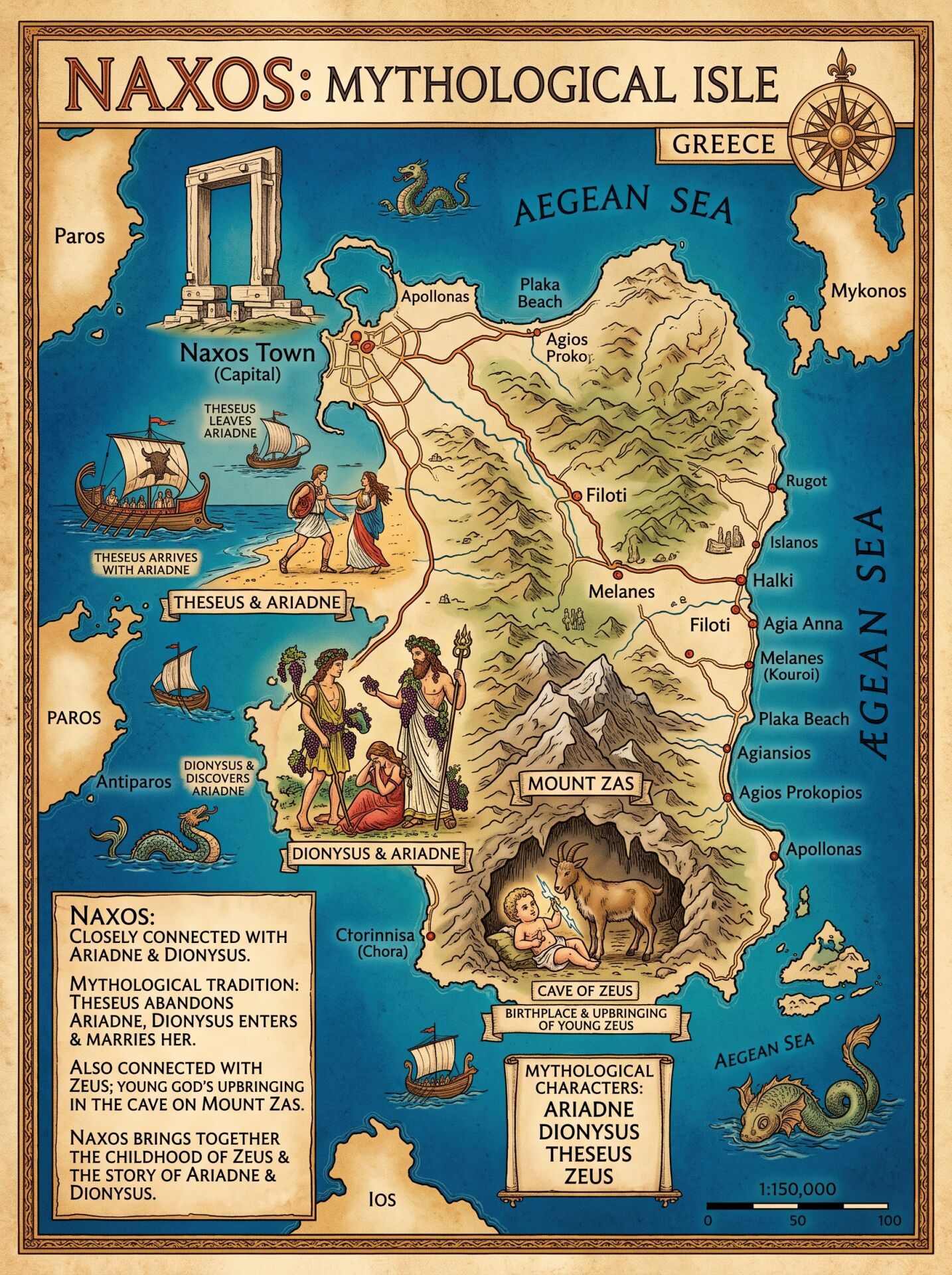
Mythological sites and characters of Naxos, reflecting the island’s rich heritage in Greek mythology.
Mythological characters:
Ariadne, Dionysus, Theseus, Zeus.
3. Ithaca
If there is one Greek island almost inseparable from a mythological hero, it is Ithaca.
Ithaca is the legendary homeland of Odysseus, the central hero of Homer's Odyssey.
After the Trojan War, Odysseus begins a long journey filled with extraordinary encounters. He meets Circe, the Sirens, the Cyclops Polyphemus, Scylla and Charybdis, while repeatedly facing the power of the gods.
Yet his ultimate goal remains the same:
to return to Ithaca.
There, Penelope and his son Telemachus await him.
Ithaca therefore became a timeless symbol of homecoming, homeland, and the journey itself.
Mythological characters:
Odysseus, Penelope, Telemachus, Laertes
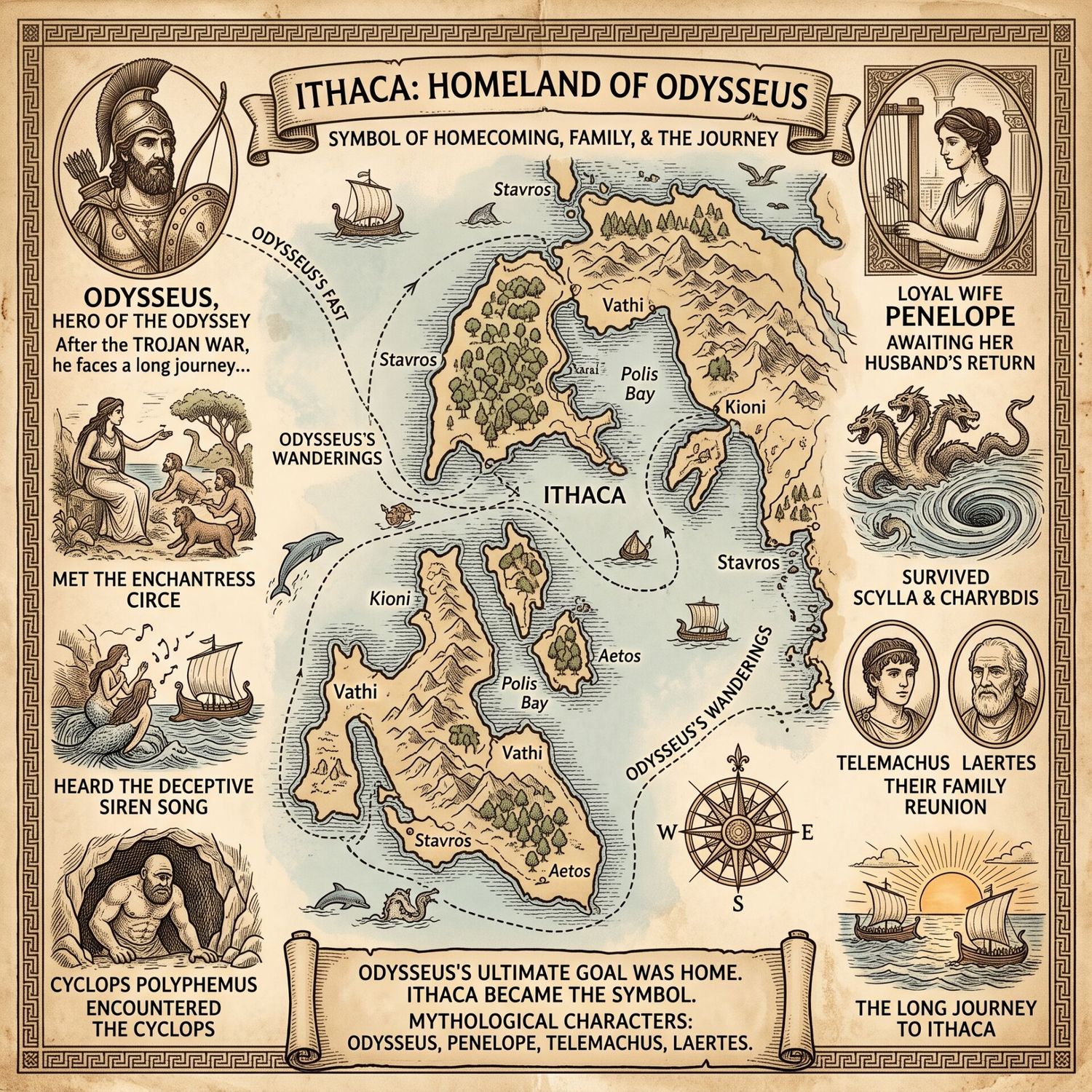
This detailed map of Ithaca highlights the legendary journey of Odysseus, featuring key mythological figures and locations central to ancient Greek storytelling.
4.Corfu
Corfu is associated with one of the final episodes of the Odyssey
Odysseus reaches the land of the Phaeacians, where he meets Nausicaa, daughter of King Alcinous.
Nausicaa helps the exhausted traveller reach her father, and from there Odysseus begins the final stage of his journey before returning to Ithaca.
The Phaeacians have traditionally been associated with Corfu.
Mythological characters:
Odysseus, Nausicaa, Alcinous.
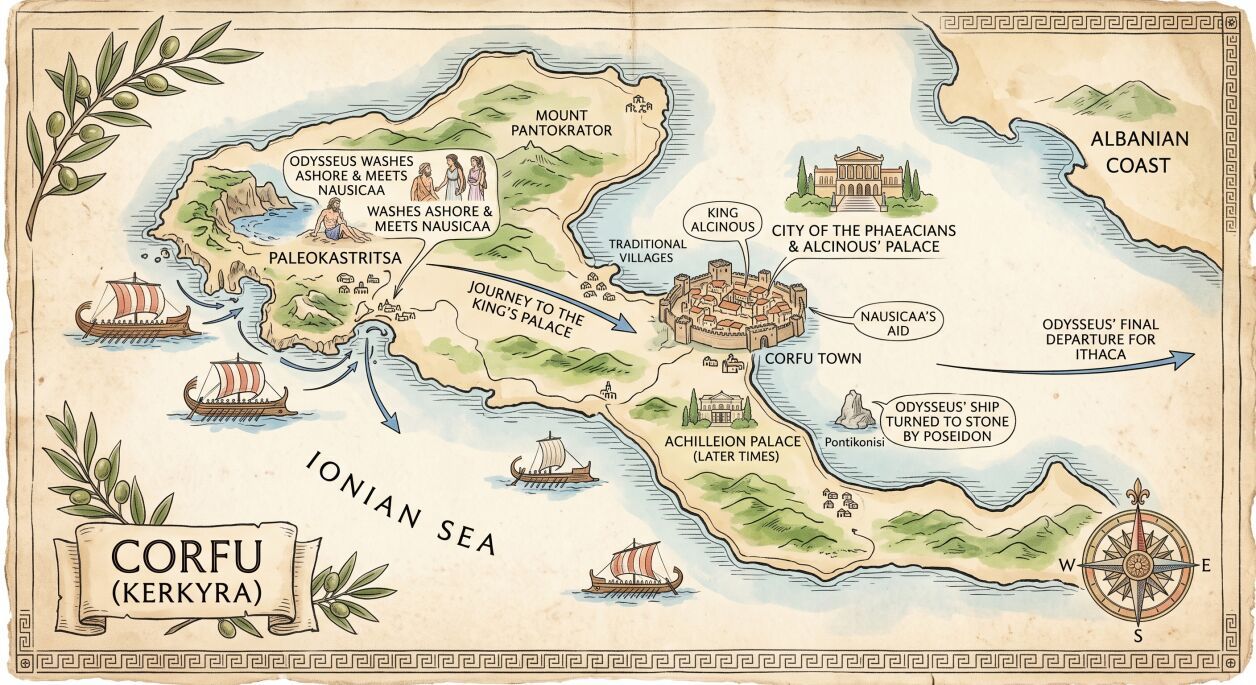
This illustrated map highlights Corfu's rich Ancient Greek mythology heritage, featuring landmarks linked to Odysseus and other legendary figures.
5.Kefalonia
Kefalonia belongs to the wider mythological world of the Ionian Islands associated with Odysseus.
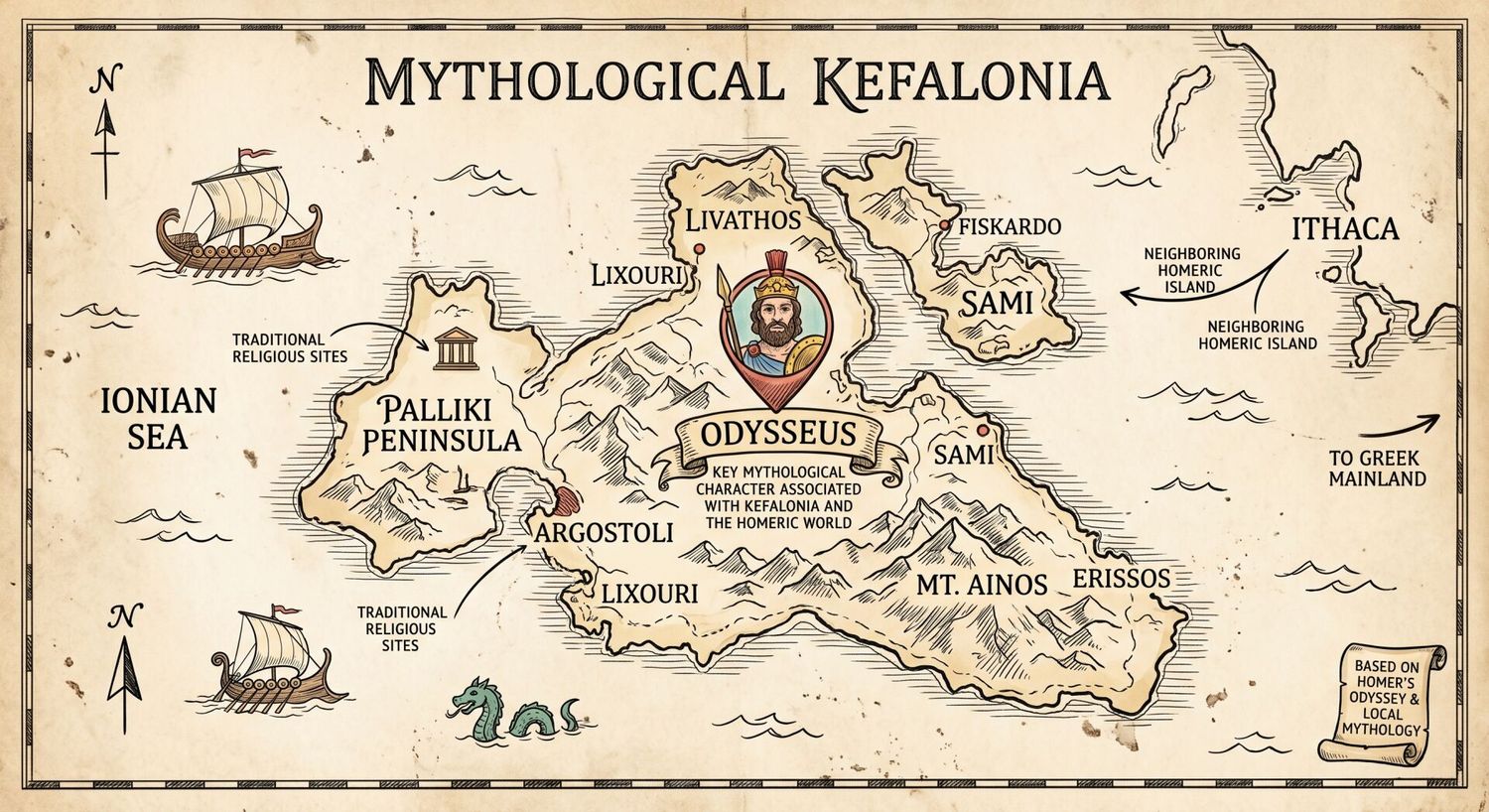
An illustrated map showcasing Kefalonia's deep mythological roots and the legend of Odysseus
The identification of modern islands with the places described in the Odyssey has fascinated scholars, travellers, and historians for centuries.
It is important, however, to distinguish ancient tradition from historical certainty.
The interest lies precisely in the meeting point between Homer, mythology, tradition, and the real landscape of the Ionian Sea.
Mythological character:
Odysseus
6. delos
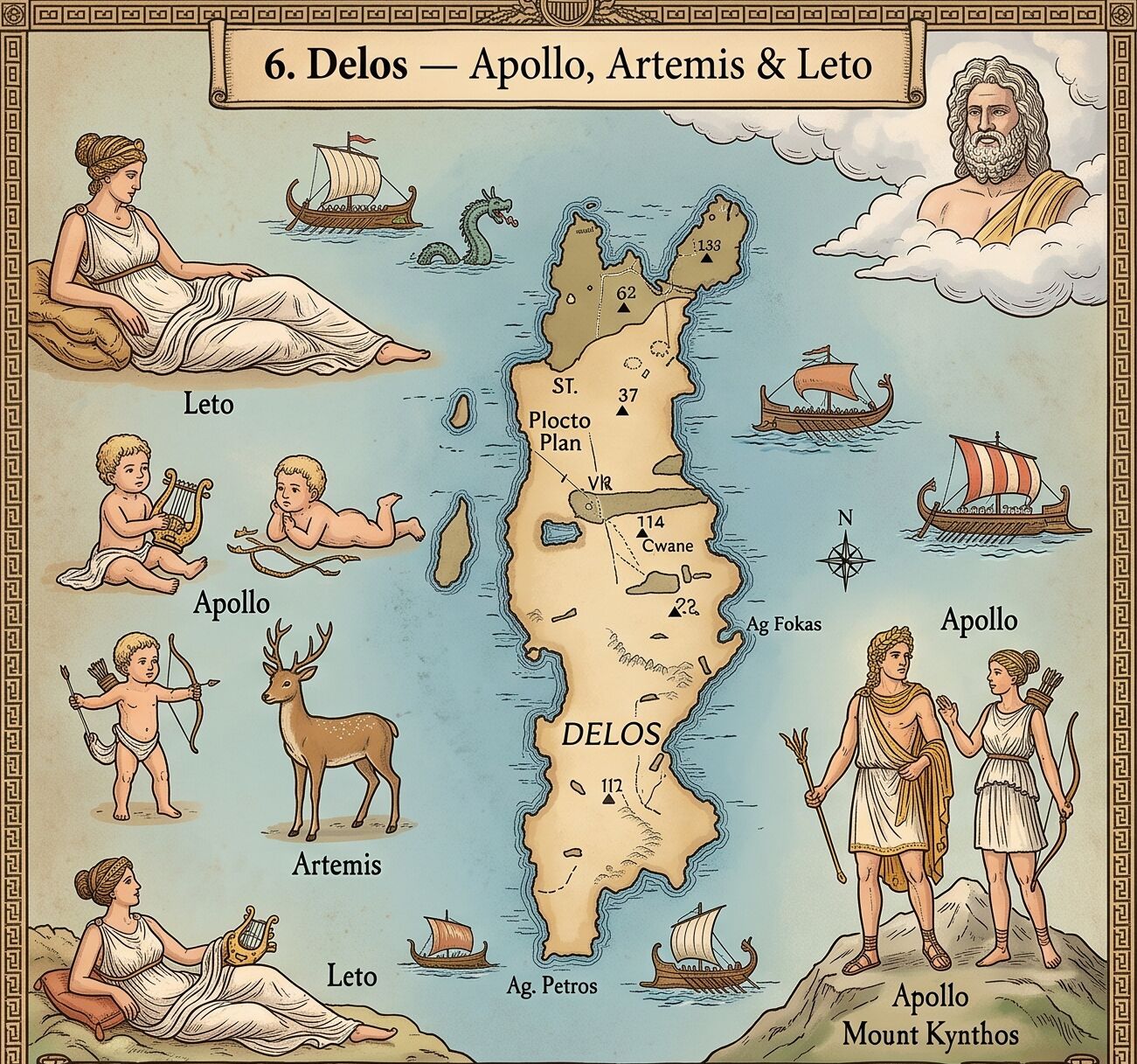
Delos is one of the most important sacred islands of ancient Greece.
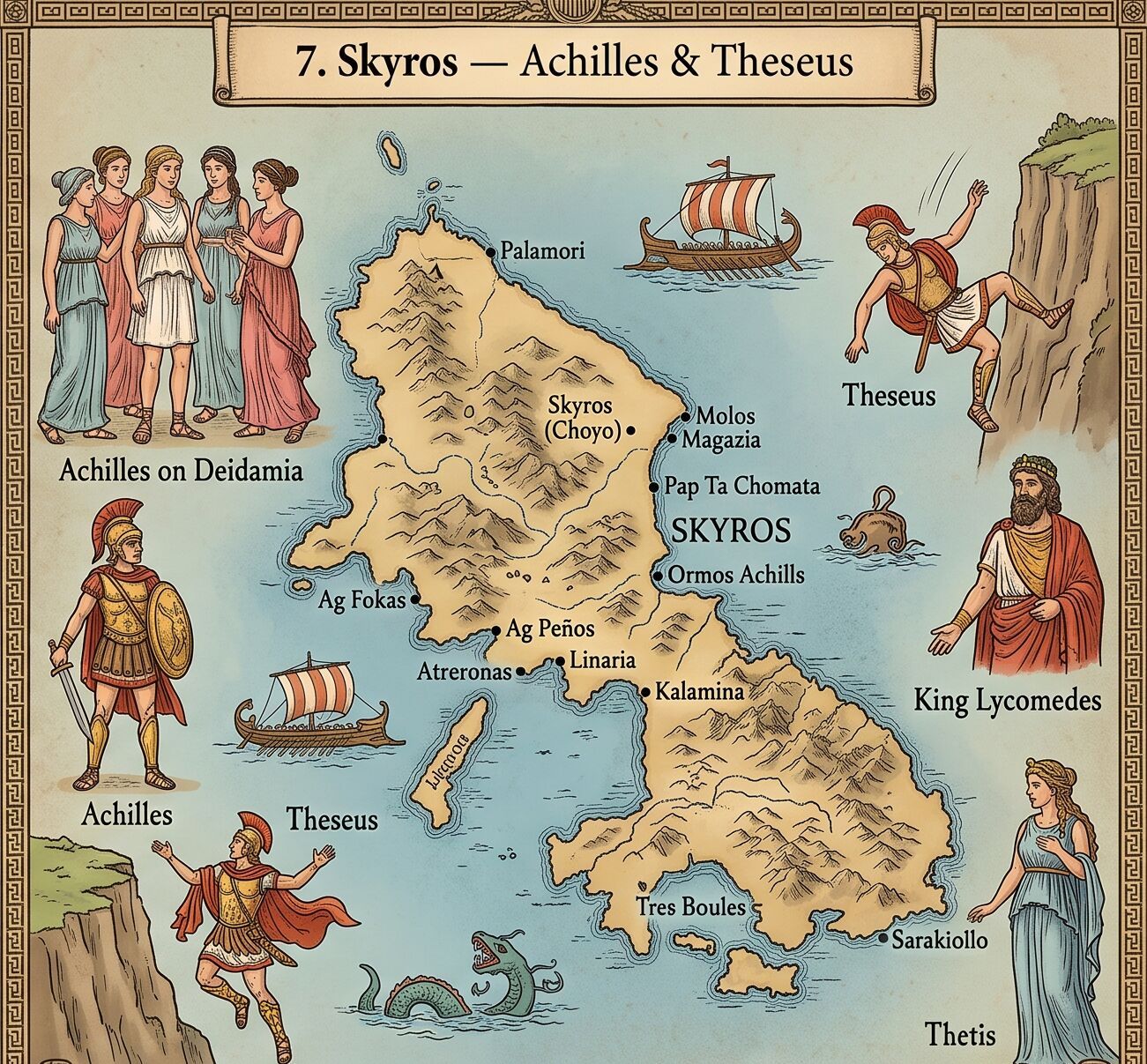
Achilles and Theseus, among the mythological figures connected to Skyros, with key locations across the island.
According to ancient mythology, it was here that Leto gave birth to the twins Apollo and Artemis, children of Zeus.
Its mythological importance was reflected in its historical development as a major religious centre.
Today, Delos is one of Greece's most important archaeological sites and a UNESCO World Heritage Site.
Mythological characters:
Apollo, Artemis, Leto, Zeus.
7.skyros
Skyros is associated with two major heroes of Greek mythology.
Apollo, Artemis and Leto on Delos, the sacred island associated with their birth.
The first is Achilles.
According to tradition, his mother, Thetis, attempted to protect him from the Trojan War by hiding him on Skyros.
There he became associated with King Lycomedes and Deidamia.
The island is also connected with Theseus, who according to tradition met his death there.
Mythological characters:
Achilles, Thetis, Theseus, Lycomedes, Deidamia
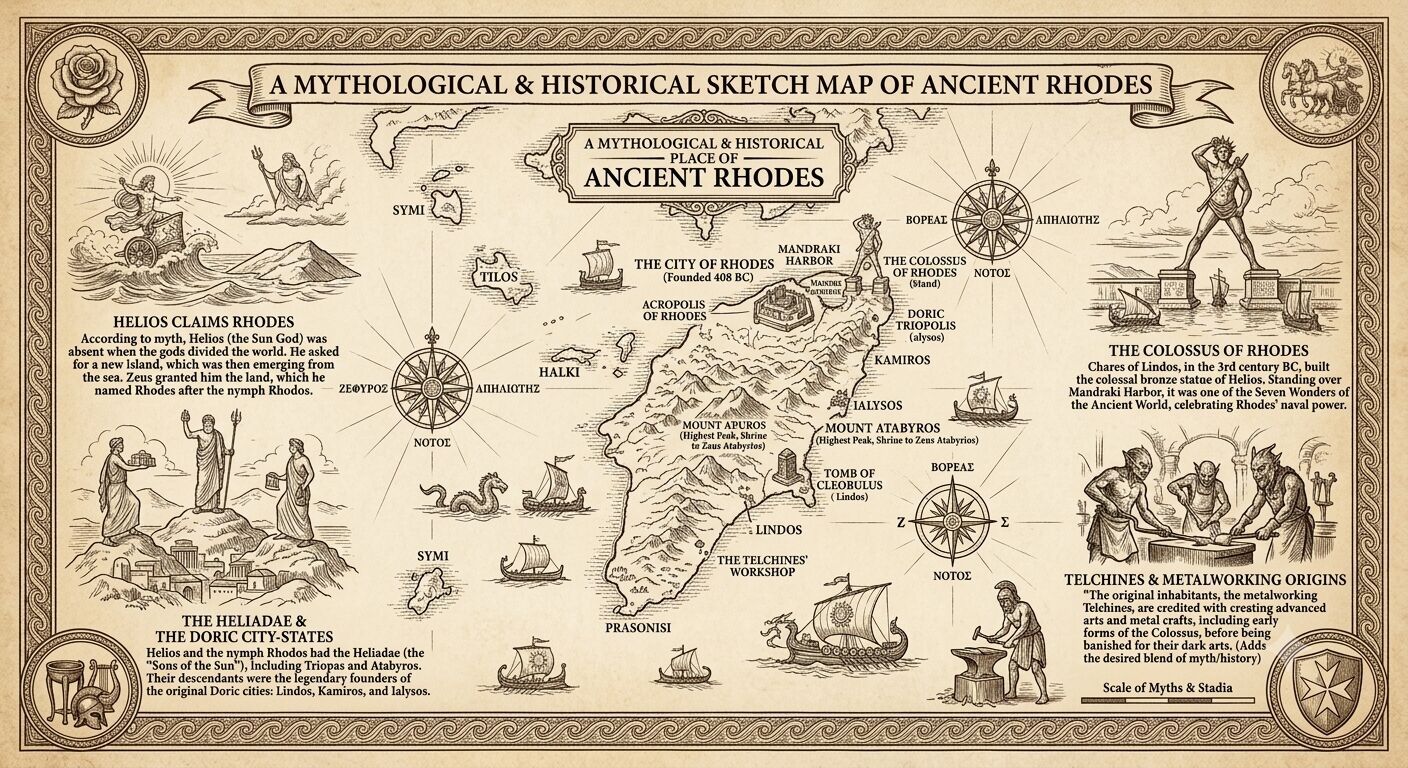
Mythical sites and figures of ancient Rhodes, where history and legend meet.
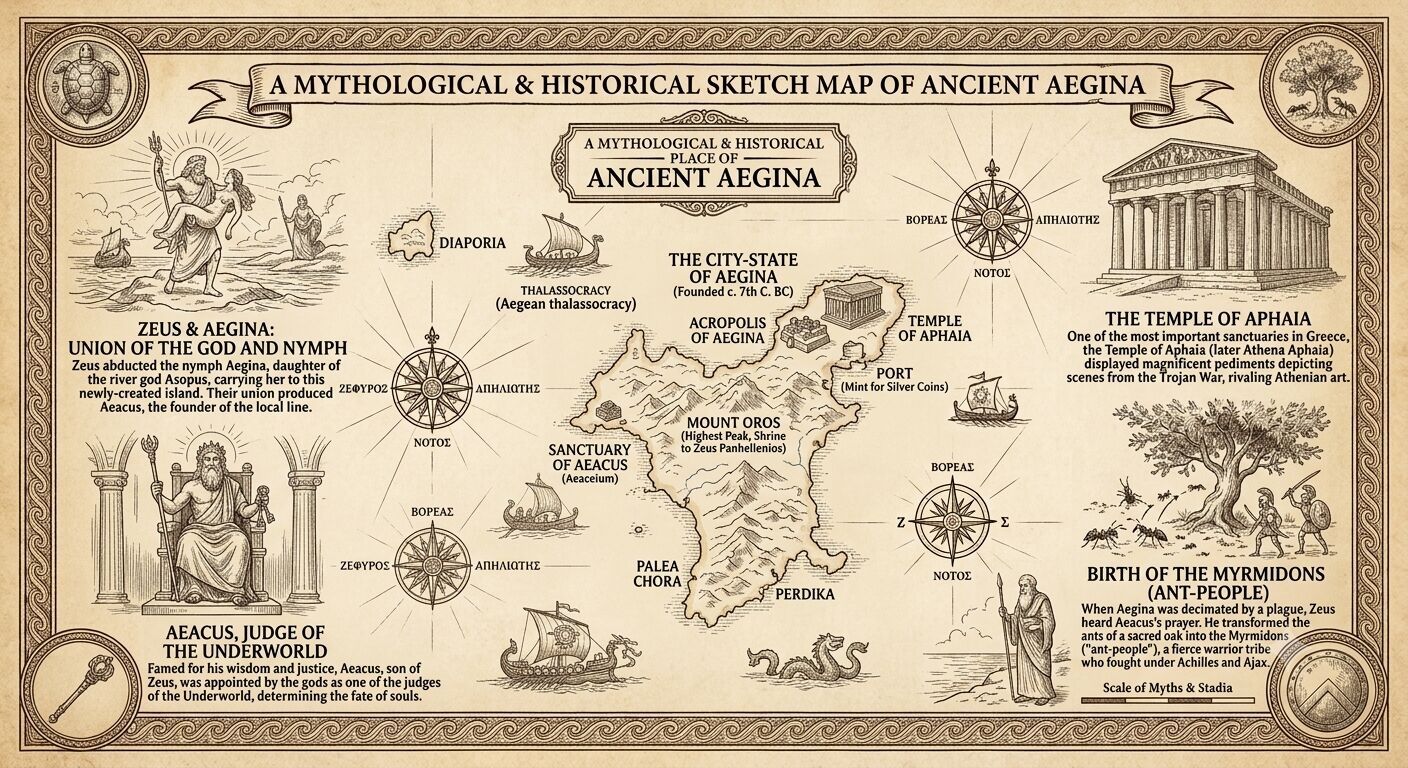
The Temple of Aphaia, the Acropolis, and other landmarks of ancient Aegina.
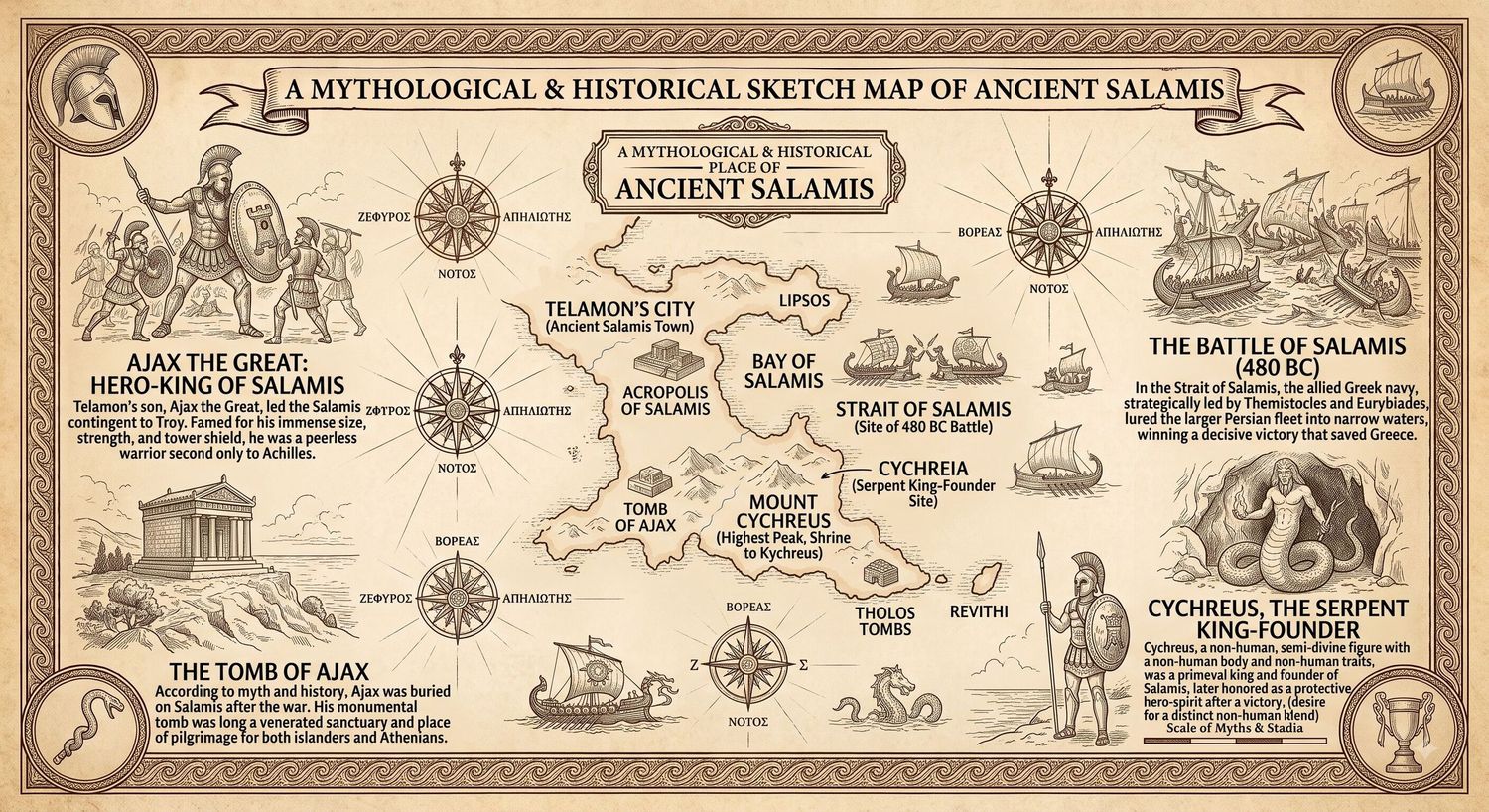
Mythological and historical landmarks of ancient Salamis, including the site of the famous Battle of 480 BC.
8. Rhodes
Rhodes has a particularly distinctive mythological figure associated with it: Helios, the god of the Sun.
Ancient tradition connected Helios so strongly with the island that his worship became one of the defining elements of ancient Rhodes.
One version of the myth tells how the gods divided the earth among themselves while Helios was absent. When he returned, he saw a new island rising from the sea — Rhodes — and claimed it as his own.
This tradition helps explain the powerful connection between Rhodes and the Sun.
Mythological character:
Helios.
9. Aegina
According to mythology, Aegina takes its name from the nymph Aegina.
Zeus fell in love with her, and their union produced Aeacus, who became the legendary king of the island.
Aeacus' family line leads to two of the most famous heroes of Greek mythology:
Achilles and Ajax.
Aegina is therefore connected indirectly to the Trojan War through an entire heroic genealogy.
Mythological characters:
Zeus, Aegina & Aeacus.
10. Salamina
Salamina, also known as Salamis, is the legendary homeland of Ajax the Great, one of the most powerful warriors on the Greek side during the Trojan War.
Ajax was the son of Telamon and took part in the Greek expedition against Troy.
In Homer's Iliad, he is portrayed as one of the strongest Greek warriors.
The connection between Salamis and Ajax is a powerful example of how a real Greek island became associated with one of the great heroes of the Trojan cycle.
Mythological characters:
Ajax, Telamon.
11. Lemnos
Lemnos is connected with two very different mythological stories.
The first concerns Hephaestus, the god of fire, metalworking, and craftsmanship.
The second concerns Philoctetes, the hero who, according to tradition, was abandoned on the island during the Greek expedition to Troy.
His story is particularly dramatic. Wounded and isolated, Philoctetes remained on Lemnos for years before eventually returning to the war.
Mythological characters: Hephaestus, Philoctetes.
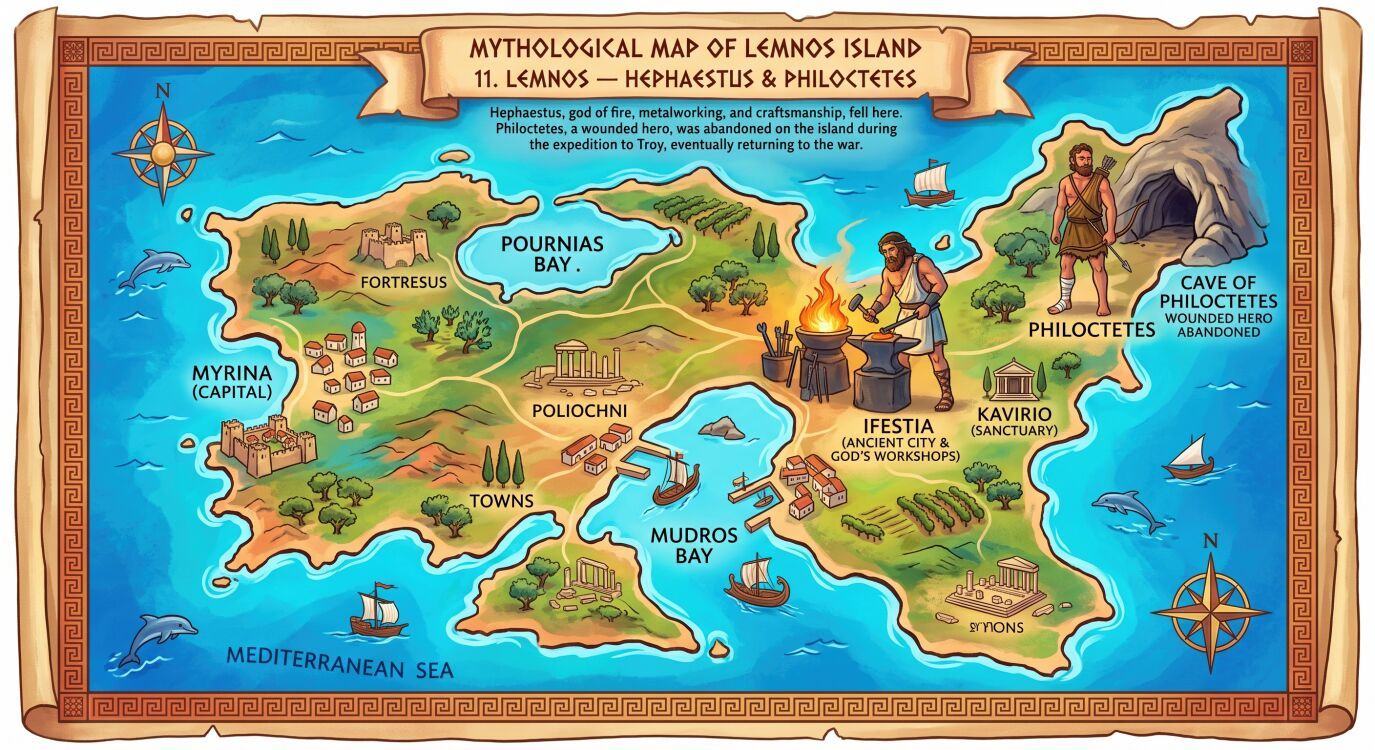
Hephaestus and Philoctetes, alongside the mythical sites, bays, and towns of Lemnos.
Mythological characters:
Hephaestus, Philoctetes
12. Samothrace
Samothrace is not associated with one single mythological hero
Its importance lies in the ancient worship of the Great Gods and the famous Mysteries of Samothrace.
The island became an important centre of mystery religion, attracting people from different parts of the ancient Greek world.
Samothrace is also forever associated with the celebrated Winged Victory of Samothrace, one of the most recognisable masterpieces of Hellenistic art.
Mythological characters:
The Great Gods, the Cabeiri, Nike
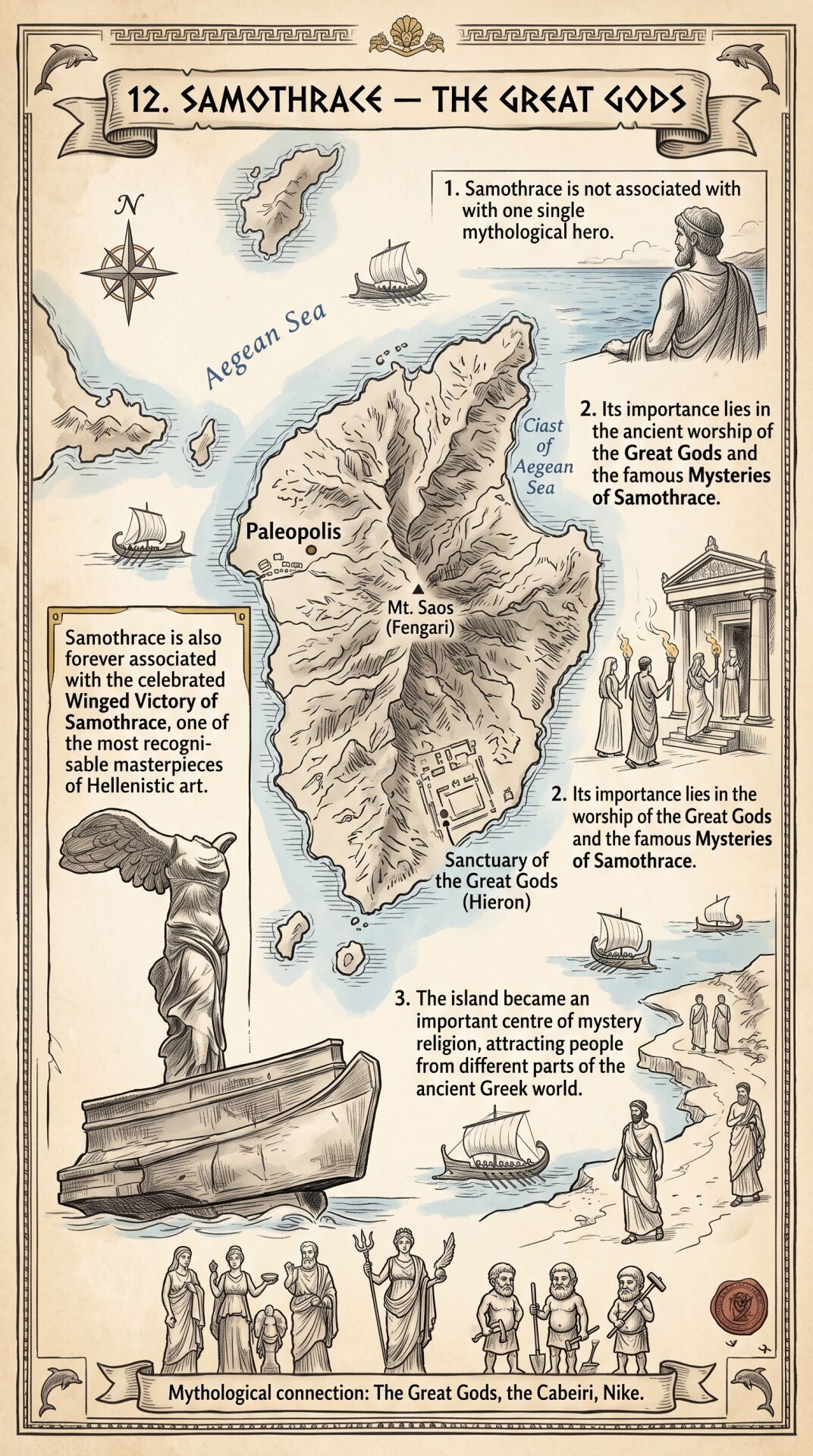
The Great Gods, mystery religion, and the iconic Winged Victory of Samothrace.
13. Nisyros
Nisyros has a myth that almost seems designed to explain its volcanic landscape
During the battle between the gods and the Giants, Poseidon pursued the giant Polybotes.
According to the tradition, Poseidon broke off a piece of the island of Kos and threw it at the giant.
That fragment became Nisyros.
Polybotes was trapped beneath the island, and his movements were associated in myth with the earthquakes and volcanic activity of the region.
Mythological characters:
Poseidon, Polybotes
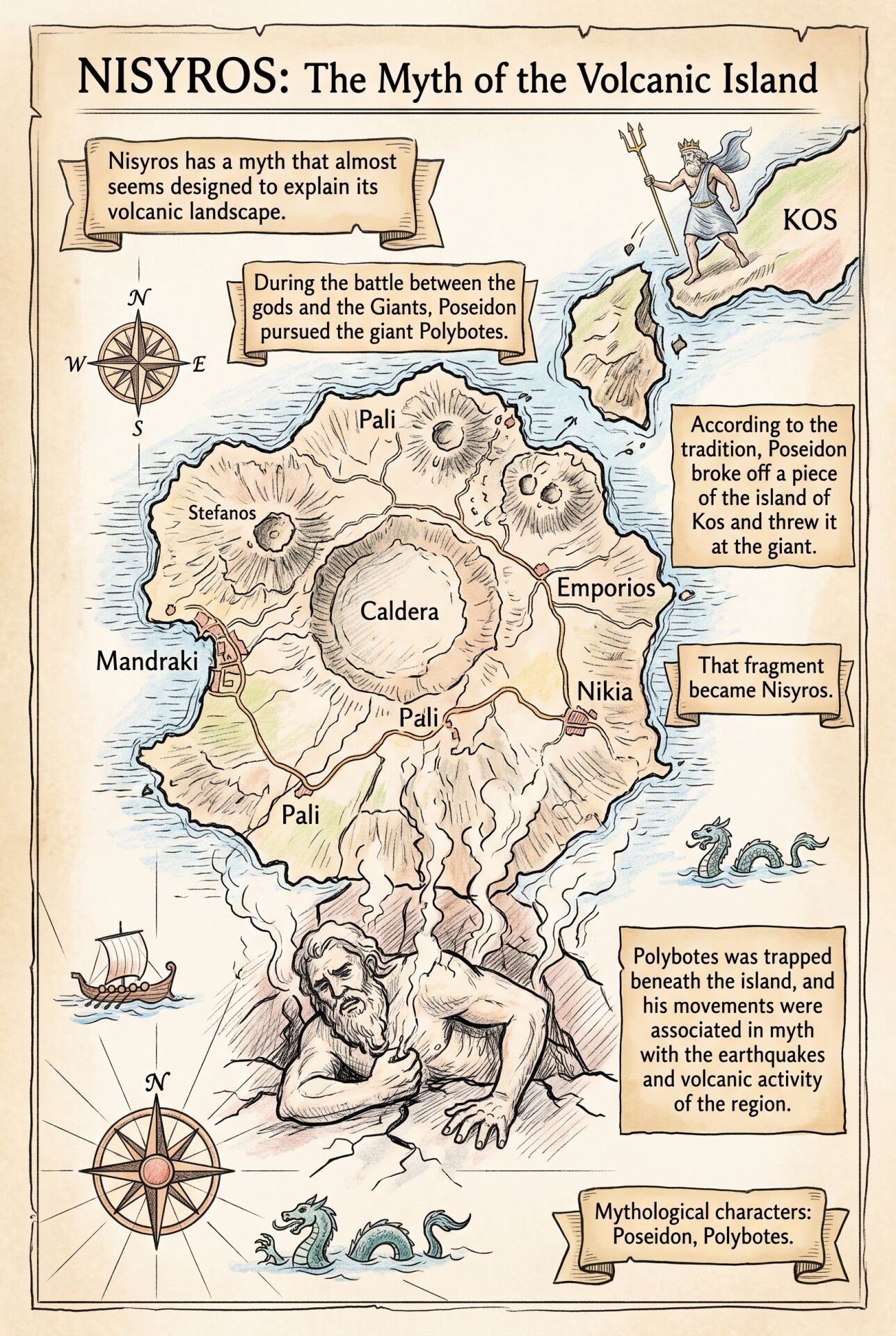
Poseidon, the giant Polybotes, and the volcanic origins of Nisyros.
14. Kythira
Kythira is one of the Greek islands most strongly associated with Aphrodite, goddess of love and beauty
The connection between the goddess and the island became particularly influential in ancient and later European art.
Over time, Kythira became a lasting symbol of love, beauty, romance, and desire.
Mythological character:
Aphrodite
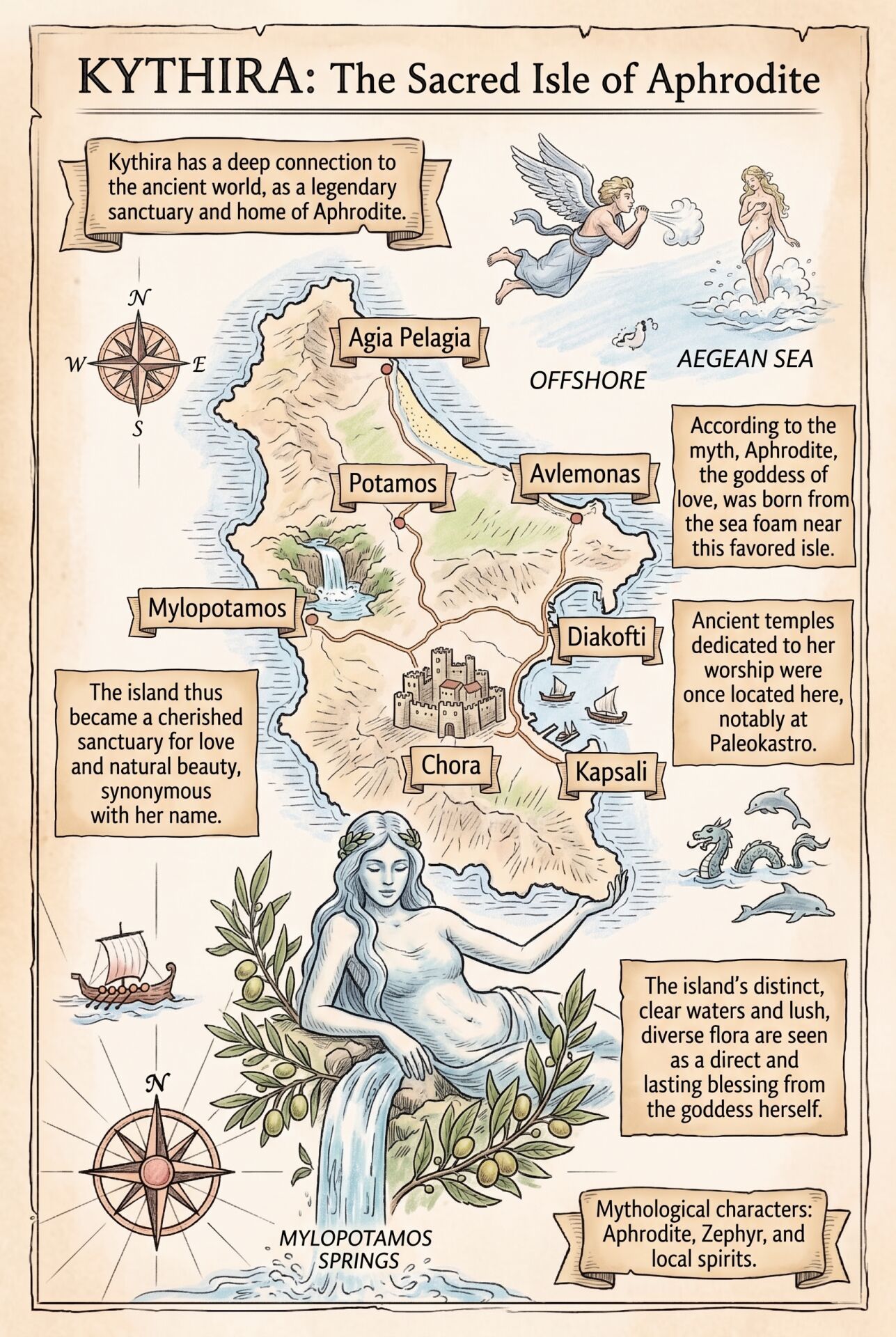
Kythira, the sacred isle of Aphrodite, rich in mythology and local legends.
15. Kos
Kos is associated with Asclepius, the god of medicine and healing, and with the ancient tradition of the Asclepieion, one of the most important healing centres of the ancient world.
The island is also connected with Heracles through mythological traditions involving the Aegean.
Kos therefore represents a different side of Greek mythology — one where gods and heroes meet the ancient pursuit of healing and medicine.
Mythological characters:
Asclepius, Heracles
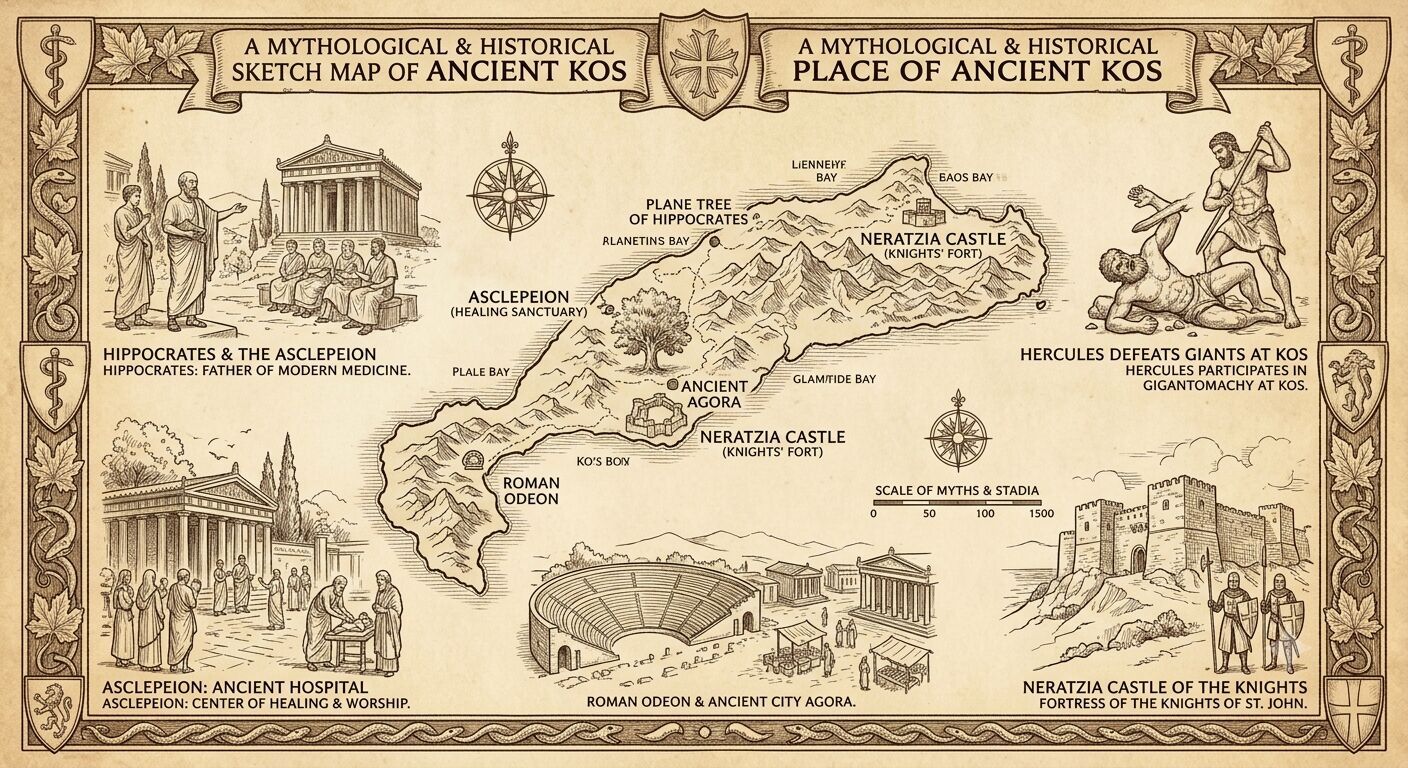
The Asclepeion, Neratzia Castle, and the ancient heritage of Kos
16. Ikaria
The name of Ikaria is inseparable from Icarus.
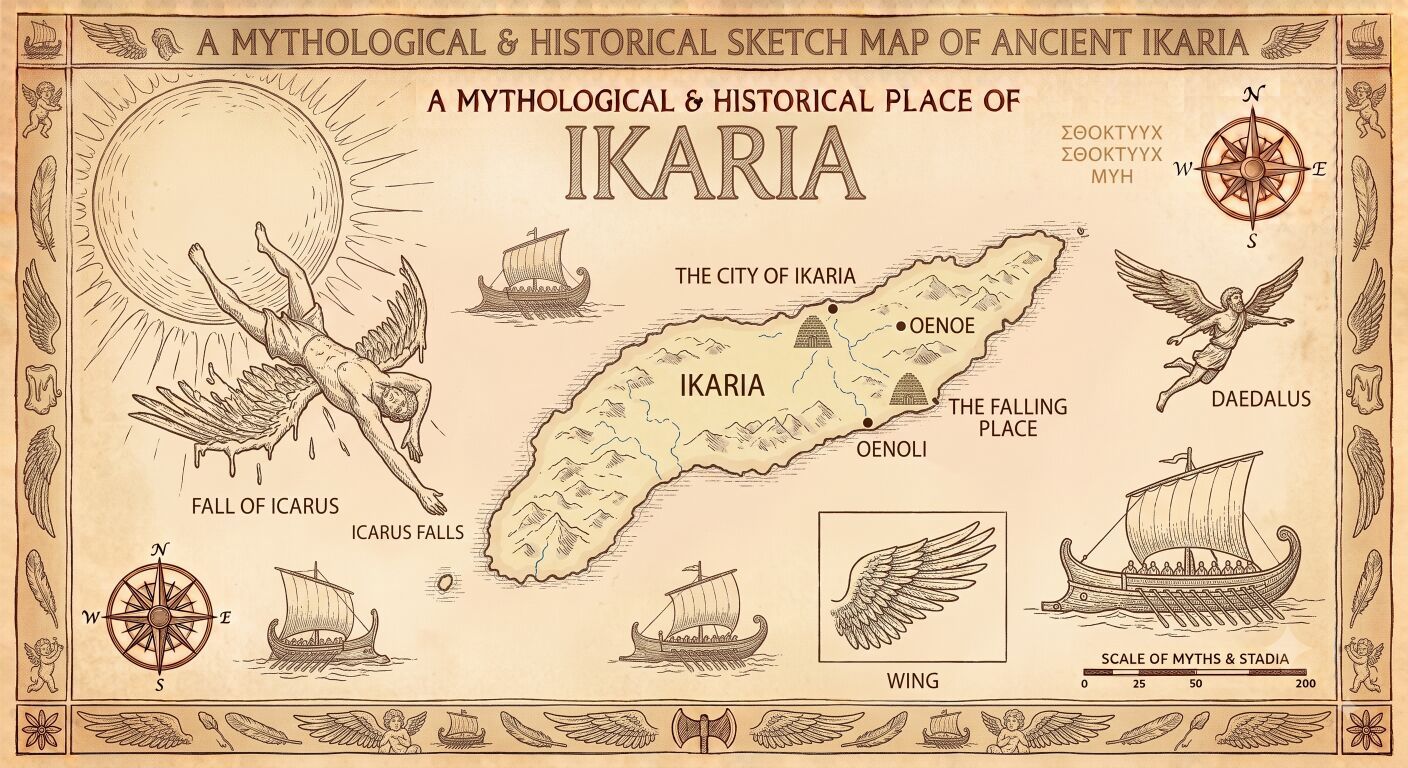
The legendary flight of Daedalus and the fall of Icarus, forever linked to Ikaria.
Icarus and his father, Daedalus, attempt to escape from Crete using wings created by Daedalus.
Icarus becomes carried away by the freedom of flight and flies too close to the Sun. The heat causes the wax holding his wings together to melt, and he falls into the sea.
The ancient tradition associated the area of his fall with the island that eventually became known as Ikaria.
Mythological characters: Icarus, Daedalus
17. Skopelos
Ancient Skopelos was known as Peparethus
The name is associated with the mythical Peparethus, who according to tradition was a son of Dionysus and Ariadne.
This creates an interesting connection between Skopelos and the better-known mythological story of Ariadne and Dionysus in Naxos.
Mythological characters:
Dionysus, Ariadne, Peparethus.
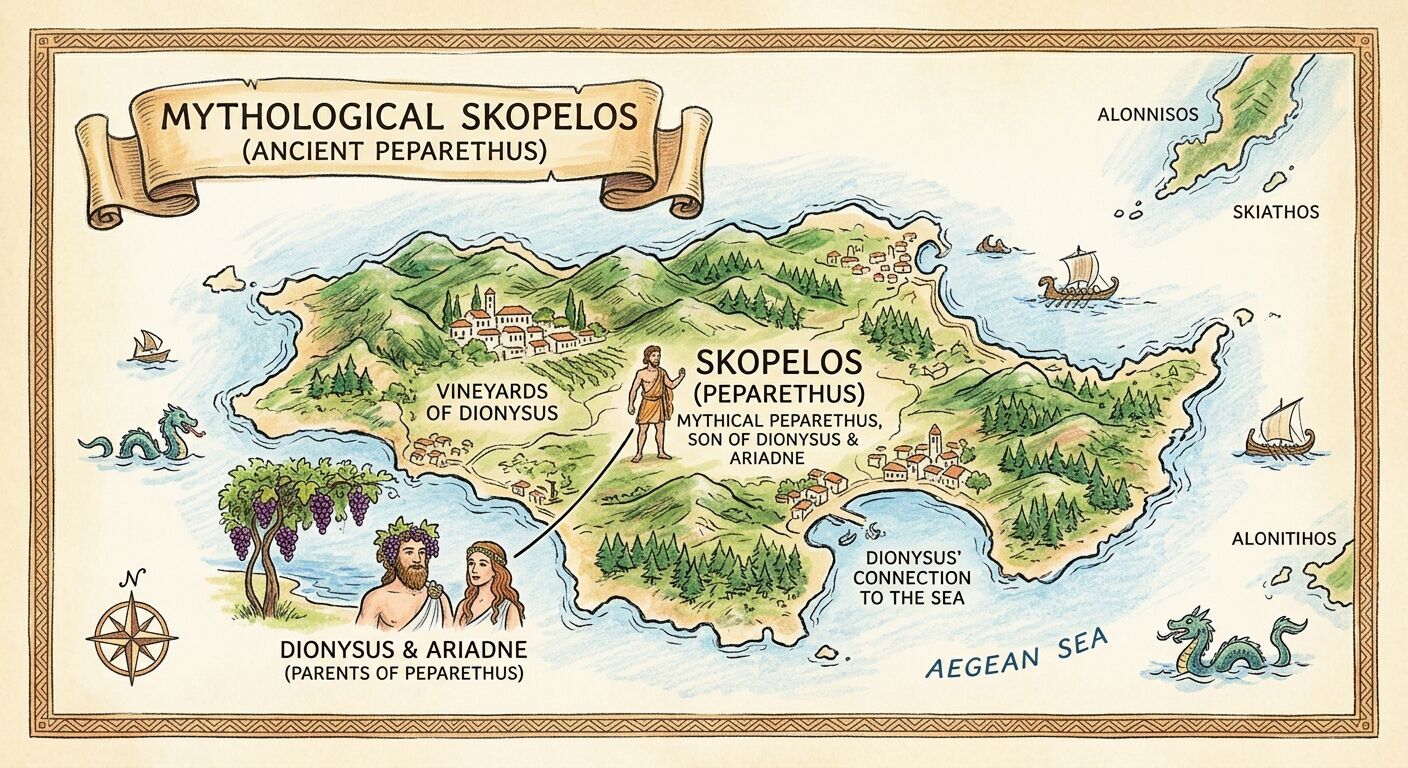
Dionysus and Ariadne, linked to the ancient island of Peparethus.
Mykonos is associated with the ancient tradition of the Gigantomachy, the great battle between the Olympian gods and the Giants.
The myth describes a cosmic struggle for control of the universe.
Mykonos and the surrounding islands became part of this mythological landscape, where the Olympian gods fought forces that challenged their authority.
Mythological characters:
Zeus, the Olympian gods and the Giants
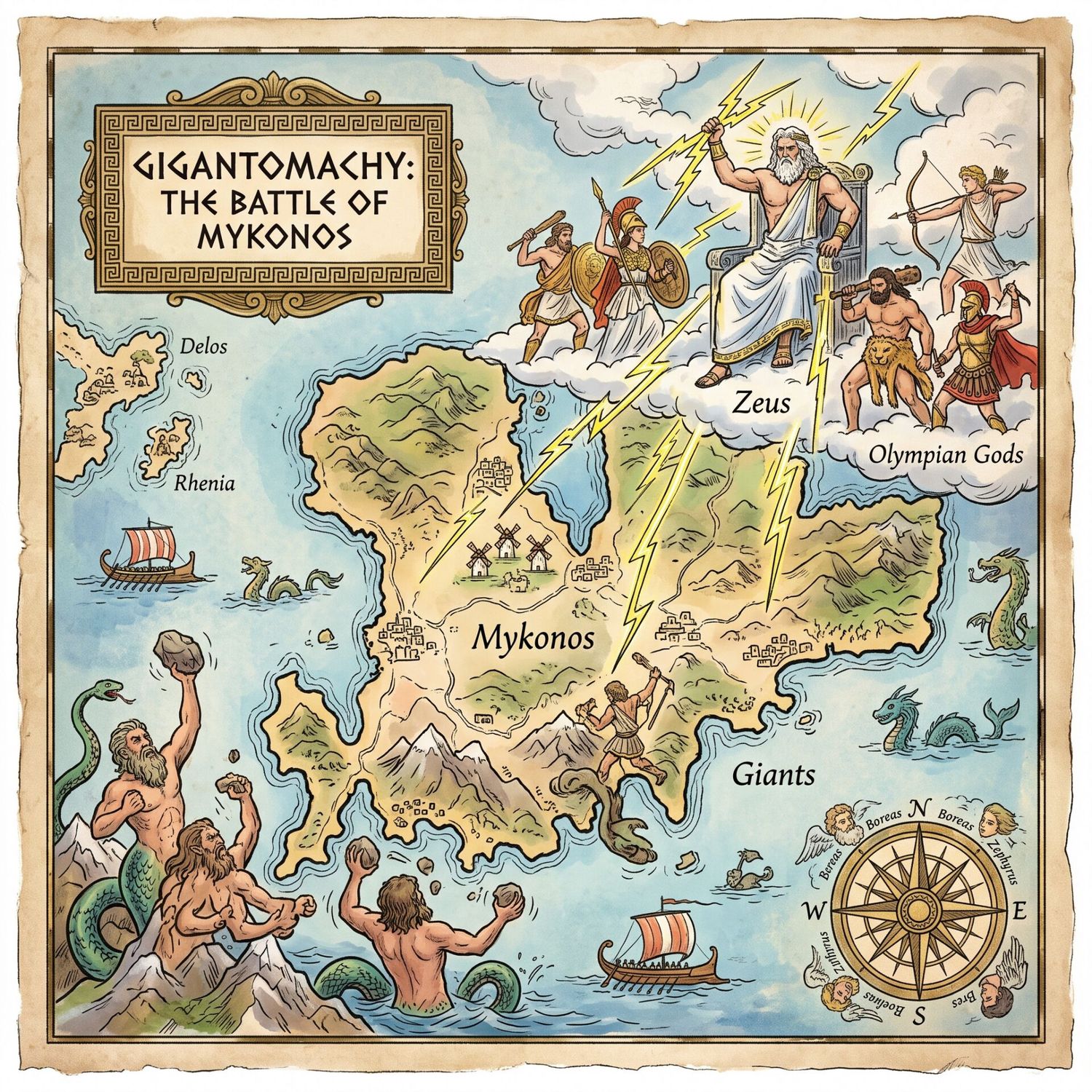
The Gigantomachy, where Zeus and the Olympian gods battle the giants.
19. Paros
Paros was already part of the religious and cultural world of the Cyclades in antiquity.
The island was associated with ancient cults and deities, while its position within the Cyclades connected it to the wider religious world centred around Delos and Apollo.
Unlike Ithaca and Odysseus or Salamis and Ajax, Paros does not have one single mythological hero who defines its identity.
Its importance lies more broadly in the religious and mythological network of the ancient Cyclades.
Mythological connection:
Mythological characters:
Ancient Cycladic cults and deities.
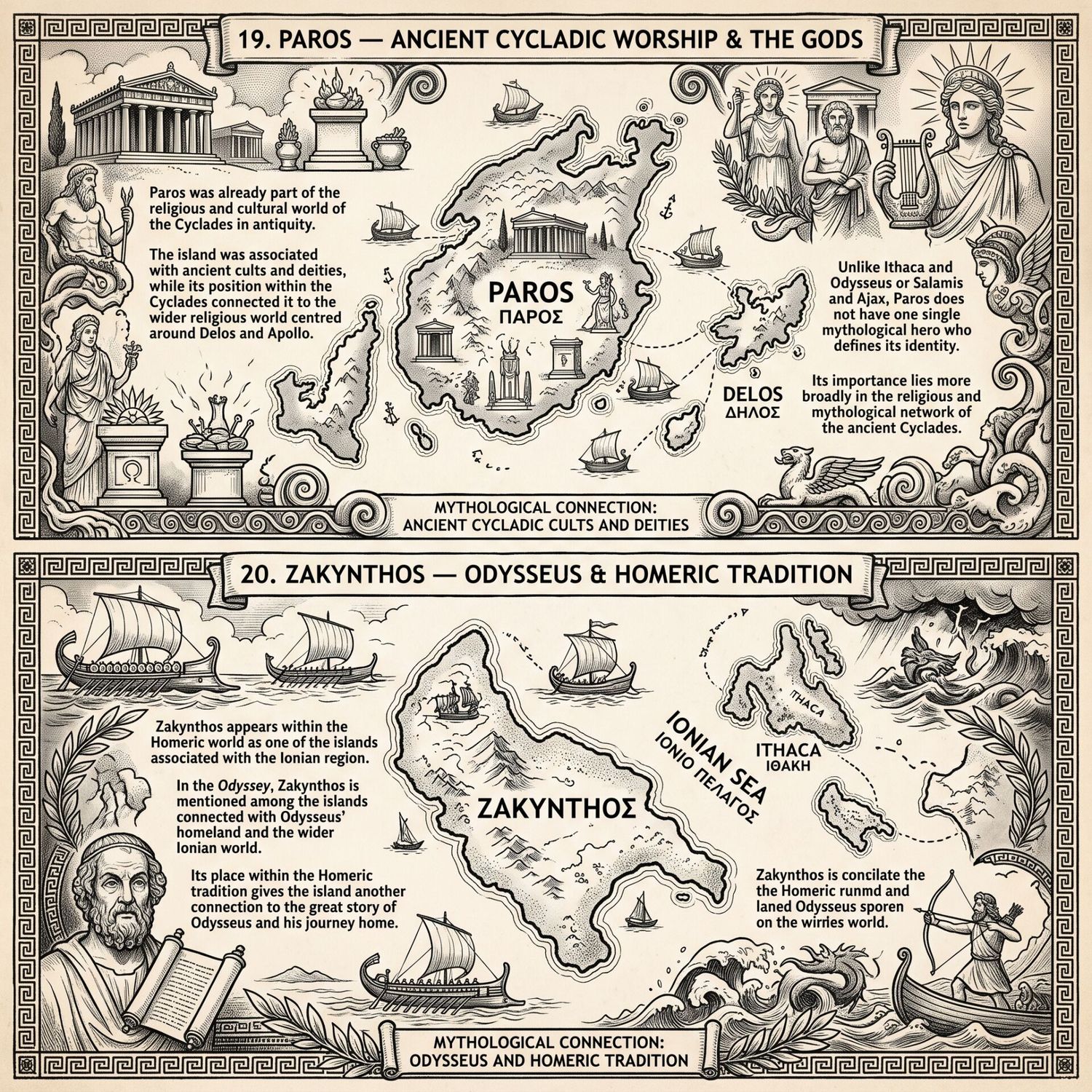
Paros and Apollo, alongside Zakynthos and its connections to Odysseus and Homeric mythology.
20. Zakynthos
Zakynthos appears within the Homeric world as one of the islands associated with the Ionian region.
In the Odyssey, Zakynthos is mentioned among the islands connected with Odysseus' homeland and the wider Ionian world.
Its place within the Homeric tradition gives the island another connection to the great story of Odysseus and his journey home.
Mythological characters:
Odysseus and Homeric tradition.
A Different Map of Greece
If we connect these 20 islands, we create a different kind of map of Greece.
Every island has its own story.
And every story has its own characters.
From the Greek Islands to Athens
Continue Your Greek Mythology Journey in Athens
Experience GreekClick — Ancient Greek Costume Photoshoot in Athens.
Discover the GreekClick Experience
The Greek islands are filled with stories that take us back to the world of Ancient Greece.
But Greek mythology does not have to remain only in the pages of a book.
You can create your own image within its world.
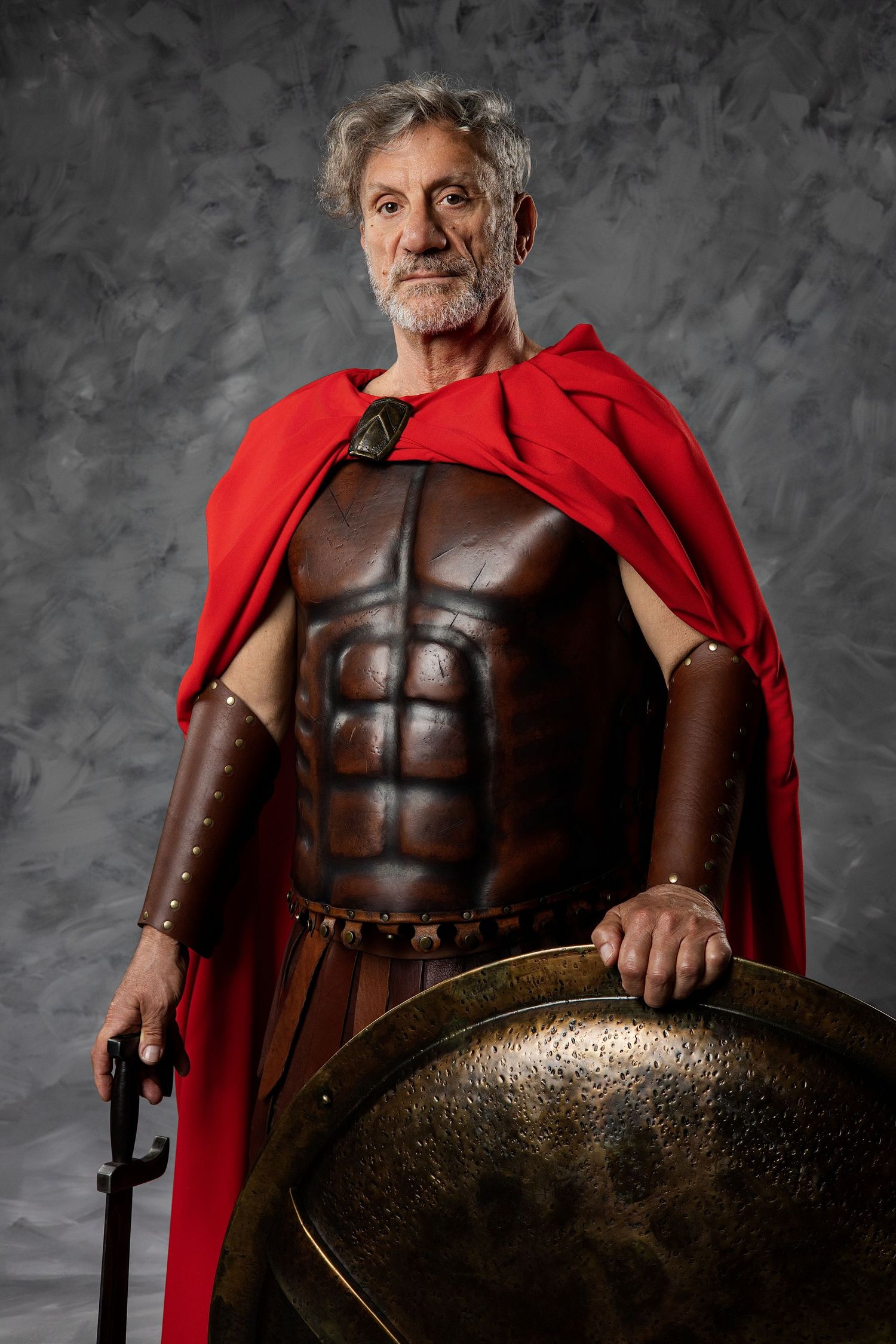
In Athens, GreekClick offers a professional photography experience inspired by Ancient Greece.
With high-quality Ancient Greek-inspired costumes, professional lighting, and carefully produced portraits, you can create your own image inspired by the world of gods, heroes, warriors, philosophers, and legendary characters.
You don't have to be a hero from the Odyssey.
You don't have to have travelled to the Crete of King Minos.
You don't have to have fought at Troy.
You simply need to step into the world of Ancient Greece for a moment.
Frequently Asked Questions
About Greek Islands and Greek Mythology
What is the most famous Greek island in mythology?
Crete is one of the most famous, with stories involving Zeus, Minos, Ariadne, Theseus, and the Minotaur.
Which Greek island is known as the home of Odysseus?
Ithaca is traditionally known as the homeland of Odysseus, the hero of Homer's *Odyssey*.
Which Greek island is linked to Apollo?
Delos is traditionally considered the birthplace of Apollo and Artemis and became one of the most important sacred islands of ancient Greece.
Where is the story of the Minotaur set?
The myth of the Minotaur is connected with Crete, particularly the Labyrinth associated with Knossos and King Minos.
Which Greek island is connected with Achilles?
Skyros is associated with Achilles, who was traditionally said to have been hidden there before the Trojan War.
Which Greek island is associated with Aphrodite?
Kythira has a strong connection with Aphrodite and became associated with love, beauty, and romance.
Which Greek island is connected with Icarus?
Ikaria is traditionally associated with Icarus and the myth of his fall after flying too close to the Sun.
Are Greek mythology and Greek history the same thing?
No. Mythology is based on ancient stories, religious traditions, and legends, while history and archaeology provide evidence about the ancient past.
Why are so many Greek islands connected with mythology?
The islands were part of the ancient Greek religious, literary, and cultural world. Over time, local traditions and famous myths became connected with their landscapes.
Can I experience Ancient Greek mythology in Athens?
Yes. At GreekClick, visitors can step into an Ancient Greek-inspired photoshoot with costumes, professional lighting, posing guidance, and professionally edited portraits.
